
Blockchain technology represents one of the most significant innovations in digital infrastructure, fundamentally changing how we think about data storage, verification, and trust in distributed systems. This educational service breaks down complex blockchain concepts into clear, digestible explanations that help learners build a solid foundation in understanding how distributed ledgers work.
Whether you're completely new to blockchain or looking to deepen your technical understanding, this guided learning path provides structured knowledge about the core principles that power decentralized networks. From cryptographic fundamentals to network architecture, we explore each component that makes blockchain technology function as a secure, transparent, and distributed system.
What is Blockchain Technology?
At its core, blockchain is a distributed database or ledger that maintains a continuously growing list of records called blocks. Each block contains a collection of transactions or data entries, along with a cryptographic hash of the previous block, creating an immutable chain of information. This structure ensures that once data is recorded, it becomes extremely difficult to alter retroactively without changing all subsequent blocks.
Unlike traditional databases controlled by a central authority, blockchain operates across a network of computers (nodes) that collectively maintain and validate the ledger. This distributed nature eliminates single points of failure and creates a system where trust is established through mathematical verification rather than relying on intermediaries.
The technology derives its name from its structure: blocks of data linked together in a chronological chain. Each block serves as a permanent record that, once added to the chain, becomes part of an unchangeable historical ledger accessible to all network participants.


How Distributed Ledgers Work
A distributed ledger is a database that exists across multiple locations or among multiple participants. In blockchain systems, every node in the network maintains a complete copy of the ledger, ensuring redundancy and eliminating the need for a central data repository. This distribution creates resilience against failures and attacks while enabling transparent verification of all recorded information.
Replication
Every participating node maintains an identical copy of the entire ledger, ensuring data availability and preventing single points of failure in the network.
Synchronization
Nodes continuously communicate to synchronize their ledger copies, ensuring all participants have access to the most current and accurate version of the data.
Validation
Before adding new data, the network collectively validates transactions through consensus mechanisms, ensuring only legitimate entries are recorded.
When a new transaction occurs, it is broadcast to all nodes in the network. These nodes then validate the transaction according to predetermined rules and cryptographic verification. Once validated, the transaction is combined with other transactions to form a new block. This block is then added to the chain through a consensus process, and all nodes update their copies of the ledger accordingly.

The distributed nature of the ledger means that tampering with historical records would require simultaneously altering the majority of copies across the network—a practically impossible task in well-established blockchain systems. This inherent security feature makes blockchain particularly valuable for applications requiring immutable record-keeping and transparent audit trails.
Understanding Consensus Mechanisms
Consensus mechanisms are the protocols that enable distributed networks to agree on the current state of the blockchain without requiring a central authority. These mechanisms solve the fundamental challenge of achieving agreement among multiple parties who may not trust each other, ensuring that all nodes maintain identical copies of the ledger and preventing fraudulent transactions.
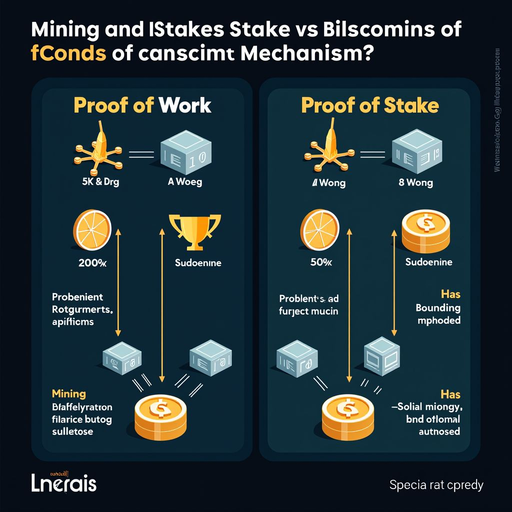
Proof of Work (PoW)
Proof of Work is the original consensus mechanism used by many blockchain networks. In this system, nodes called miners compete to solve complex mathematical puzzles. The first miner to solve the puzzle gets the right to add the next block to the chain and receives a reward for their computational effort.
The puzzle-solving process requires significant computational power, making it economically expensive to attack the network. An attacker would need to control more than 50% of the network's total computing power to successfully manipulate the blockchain—a prohibitively costly endeavor in established networks.
- Highly secure and battle-tested
- Decentralized and permissionless
- Resistant to various attack vectors
- High energy consumption
- Slower transaction processing
- Requires specialized hardware
Proof of Stake (PoS)
Proof of Stake represents an alternative approach where validators are chosen to create new blocks based on the amount of cryptocurrency they hold and are willing to "stake" as collateral. Instead of competing through computational work, validators are selected through a combination of factors including stake size, coin age, and randomization.
Validators who act maliciously risk losing their staked assets, creating a strong economic incentive for honest behavior. This mechanism significantly reduces energy consumption while maintaining network security through economic penalties rather than computational difficulty.
- Energy efficient
- Faster transaction finality
- Lower barrier to participation
- Potential wealth concentration
- Newer and less tested
- Different security assumptions
Beyond these two primary mechanisms, various hybrid and alternative consensus protocols exist, each designed to optimize different aspects of blockchain performance such as speed, security, decentralization, or energy efficiency. Understanding these mechanisms is crucial for evaluating different blockchain networks and their suitability for specific applications.
Cryptographic Principles in Blockchain
Cryptography forms the mathematical foundation that makes blockchain technology secure and trustworthy. Through sophisticated cryptographic techniques, blockchain systems ensure data integrity, authenticate participants, and maintain privacy while operating in a transparent, distributed environment. Understanding these principles helps clarify how blockchain achieves security without central oversight.
Hash Functions
Cryptographic hash functions convert data of any size into fixed-length strings of characters. These functions are one-way, meaning you cannot reverse the process to discover the original input. Each block in a blockchain contains a hash of the previous block, creating the chain's immutable structure. Even the smallest change to input data produces a completely different hash, making tampering immediately detectable.
Public Key Cryptography
This asymmetric encryption system uses pairs of keys: a public key that can be shared openly and a private key kept secret. Users can receive transactions to their public key address, while only the holder of the corresponding private key can authorize spending. This system enables secure transactions without requiring parties to share sensitive information.
Digital Signatures
Digital signatures prove that a transaction was authorized by the owner of a private key without revealing the key itself. When creating a transaction, users sign it with their private key, producing a unique signature. Other network participants can verify this signature using the corresponding public key, confirming authenticity without compromising security.
Merkle Trees
Merkle trees organize transaction data in a hierarchical structure where each leaf node represents a transaction hash, and parent nodes contain hashes of their children. This structure allows efficient verification of specific transactions without downloading the entire blockchain, enabling lightweight clients to participate in the network while maintaining security.

Node Operations and Network Architecture
Nodes are the individual computers that collectively form a blockchain network. Each node plays a crucial role in maintaining the distributed ledger, validating transactions, and ensuring network security. Understanding how nodes operate and interact provides insight into the decentralized nature of blockchain systems and how they achieve consensus without central coordination.
Types of Nodes
Full Nodes
Full nodes download and store the complete blockchain history, independently verifying every transaction and block according to network rules. They serve as the backbone of the network, ensuring decentralization and security by maintaining complete copies of the ledger and rejecting invalid transactions.
Light Nodes
Light nodes (or SPV nodes) store only block headers rather than complete transaction data, relying on full nodes for detailed information. This approach requires less storage and bandwidth, making blockchain participation accessible to devices with limited resources while still enabling transaction verification.
Mining Nodes
In Proof of Work systems, mining nodes compete to solve cryptographic puzzles and create new blocks. These nodes bundle pending transactions, perform computational work to find valid block hashes, and broadcast new blocks to the network. Successful miners receive rewards for their contributions to network security.
Validator Nodes
In Proof of Stake networks, validator nodes are selected to propose and validate new blocks based on their staked assets. These nodes must remain online and properly configured to participate in consensus, earning rewards for honest validation and facing penalties for malicious behavior or extended downtime.

Network Communication
Blockchain networks operate as peer-to-peer systems where nodes communicate directly without intermediaries. When a user initiates a transaction, it propagates through the network as nodes relay it to their peers. This gossip protocol ensures rapid distribution of information across the entire network, typically reaching all nodes within seconds.
Nodes maintain connections to multiple peers, creating a resilient mesh network that continues functioning even if individual nodes fail or disconnect. This redundancy ensures network availability and prevents single points of failure. The decentralized architecture means no single entity controls the network, and censorship becomes practically impossible as long as sufficient honest nodes remain operational.
Transaction Broadcast
User creates and signs transaction, broadcasting it to connected nodes
Network Propagation
Nodes validate and relay transaction to their peers across the network
Block Inclusion
Miners or validators include transaction in new block through consensus
The network architecture balances several competing factors: decentralization (ensuring no single entity controls the system), security (protecting against attacks and fraud), and scalability (processing transactions efficiently). Different blockchain implementations make different trade-offs among these factors, leading to diverse network designs optimized for specific use cases and requirements.
Your Learning Path Forward
Understanding blockchain technology requires building knowledge progressively, starting with fundamental concepts and gradually exploring more complex topics. This educational service provides a structured approach to learning, ensuring you develop a solid foundation before advancing to specialized areas of blockchain technology and its applications.
Recommended Learning Sequence
Foundation Concepts
Master the basics of distributed systems, cryptography fundamentals, and how blockchain differs from traditional databases. Understand the problems blockchain solves and the trade-offs involved in decentralized systems.
Technical Architecture
Dive deeper into block structure, transaction formats, and network protocols. Learn how nodes communicate, how consensus is achieved, and how the system maintains security through cryptographic techniques.
Consensus Mechanisms
Explore different consensus algorithms in detail, understanding their security models, performance characteristics, and trade-offs. Compare Proof of Work, Proof of Stake, and alternative mechanisms used by various blockchain networks.
Network Operations
Study how blockchain networks function in practice, including node operations, network topology, peer discovery, and data propagation. Understand the practical considerations of running and maintaining blockchain infrastructure.
Advanced Topics
Progress to specialized areas such as smart contracts, layer-2 scaling solutions, cross-chain interoperability, and emerging blockchain innovations. Explore how blockchain technology continues evolving to address current limitations.

Building Practical Understanding
While theoretical knowledge provides essential foundation, developing practical understanding requires hands-on exploration. Blockchain explorers allow you to examine real transactions, blocks, and network activity, helping visualize how concepts work in practice. Test networks provide safe environments for experimentation without financial risk.
As you progress through your learning journey, focus on understanding the "why" behind blockchain design decisions. Every technical choice involves trade-offs between decentralization, security, scalability, and efficiency. Recognizing these trade-offs helps evaluate different blockchain implementations and understand their suitability for various applications.
This educational service provides the foundation you need to understand blockchain technology comprehensively. By mastering these core concepts—distributed ledgers, consensus mechanisms, cryptographic principles, and network architecture—you'll be well-equipped to explore specific blockchain applications, evaluate different platforms, and understand the technology's potential impact on various industries and use cases.