Understanding Blockchain Consensus Mechanisms
A comprehensive guide to how decentralized networks reach agreement and validate transactions

At the heart of every blockchain network lies a fundamental challenge: how can a distributed system of independent computers agree on a single version of truth without relying on a central authority? This question is answered through consensus mechanisms—the protocols that enable blockchain networks to validate transactions, maintain security, and ensure all participants share the same record of events.
Consensus mechanisms are what make blockchain technology truly revolutionary. They solve the Byzantine Generals Problem, a classic computer science challenge about achieving agreement in a distributed system where some participants might be unreliable or malicious. Understanding how these mechanisms work provides essential insight into how blockchain networks maintain integrity and process transactions without central oversight.
What is Blockchain Consensus?
Consensus in blockchain refers to the process by which network participants agree on the current state of the distributed ledger. Unlike traditional databases where a single entity controls what gets recorded, blockchain networks require multiple independent nodes to reach agreement before any transaction is considered valid and permanently added to the chain.
The consensus mechanism serves several critical functions in a blockchain network. First, it determines which participant has the right to add the next block of transactions to the chain. Second, it ensures that all nodes maintain identical copies of the ledger. Third, it provides security by making it economically or computationally impractical for malicious actors to manipulate the system. Finally, it establishes the rules for resolving conflicts when different versions of the blockchain exist temporarily.
Different blockchain networks employ different consensus mechanisms based on their specific goals and priorities. Some prioritize maximum security and decentralization, while others optimize for transaction speed and energy efficiency. The choice of consensus mechanism fundamentally shapes how a blockchain network operates and what trade-offs it accepts.
Key Insight
Consensus mechanisms are the foundation of blockchain's trustless nature. They enable strangers to transact and cooperate without needing to trust each other or rely on an intermediary, because the protocol itself enforces honest behavior through economic incentives and cryptographic verification.
Proof of Work: The Original Consensus Model
Proof of Work (PoW) is the consensus mechanism that powered Bitcoin, the first successful blockchain network. In PoW systems, network participants called miners compete to solve complex mathematical puzzles. The first miner to solve the puzzle earns the right to add the next block to the blockchain and receives a reward for their effort. This process is called mining because it resembles the extraction of valuable resources through intensive work.

The mathematical puzzle in PoW involves finding a number (called a nonce) that, when combined with the block's data and passed through a cryptographic hash function, produces a result meeting specific criteria. This requires enormous computational effort through trial and error, but verifying that a solution is correct takes minimal resources. This asymmetry is crucial—it's hard to find a valid block but easy for others to confirm its validity.
How Proof of Work Provides Security
The security of PoW comes from the sheer amount of computational work required to create valid blocks. To alter past transactions, an attacker would need to redo all the computational work for that block and every subsequent block, while simultaneously outpacing the honest miners adding new blocks. This becomes exponentially more difficult as more blocks are added, making older transactions increasingly secure.
The economic incentive structure reinforces this security. Miners invest in expensive hardware and consume significant electricity to participate. Attempting to attack the network would require controlling more than half the total computational power (a 51% attack), which would be extraordinarily expensive. Moreover, successfully attacking the network would likely destroy the value of the cryptocurrency, making the attack economically irrational for the attacker who has invested heavily in mining equipment.
Trade-offs and Limitations
While PoW has proven remarkably secure and reliable, it comes with significant trade-offs. The primary criticism is energy consumption—PoW networks require vast amounts of electricity to maintain security. The competitive nature of mining also leads to centralization pressures, as miners with access to cheaper electricity and more efficient hardware gain advantages. Additionally, PoW networks typically have limited transaction throughput, as the time required to solve puzzles and propagate blocks across the network creates natural speed limits.
Proof of Stake: An Alternative Approach
Proof of Stake (PoS) represents a fundamentally different approach to achieving consensus. Instead of miners competing through computational work, PoS networks select validators based on the amount of cryptocurrency they hold and are willing to "stake" as collateral. Validators are chosen to create new blocks through various selection mechanisms, often involving randomization weighted by stake size.
The core principle of PoS is that validators have "skin in the game" through their staked assets. If a validator attempts to validate fraudulent transactions or acts maliciously, they risk losing their staked cryptocurrency through a process called slashing. This economic penalty creates a strong incentive for honest behavior. Validators earn rewards for correctly validating blocks, providing the positive incentive to participate honestly.
Advantages of Proof of Stake
PoS offers several advantages over PoW. Energy consumption is dramatically lower because validators don't need to perform intensive computational work—they simply need to run software that validates transactions and creates blocks. This makes PoS networks more environmentally sustainable and reduces the ongoing costs of network security. PoS systems can also achieve higher transaction throughput and faster finality, as they're not constrained by the time required to solve computational puzzles.
The barrier to entry for participation can be lower in PoS systems. While becoming a competitive PoW miner requires significant capital investment in specialized hardware, PoS validators primarily need to acquire and stake the network's cryptocurrency. Many PoS networks also allow smaller holders to delegate their stake to validators, enabling broader participation in network security.
Challenges and Considerations
PoS systems face their own set of challenges. The "nothing at stake" problem refers to the theoretical possibility that validators might validate multiple competing chains simultaneously, since doing so costs them nothing. Various solutions have been developed to address this, including slashing conditions that penalize validators who sign conflicting blocks. Another consideration is the potential for wealth concentration, as those with more stake earn more rewards, potentially leading to increasing centralization over time.
Alternative Consensus Approaches
Beyond PoW and PoS, blockchain developers have created numerous alternative consensus mechanisms, each designed to optimize for different priorities or address specific limitations. These alternatives demonstrate the ongoing innovation in blockchain technology and the diverse approaches to solving the consensus problem.
Delegated Proof of Stake
Delegated Proof of Stake (DPoS) introduces a representative democracy model to blockchain consensus. Token holders vote to elect a limited number of delegates who are responsible for validating transactions and creating blocks. This system can achieve higher transaction speeds and throughput because fewer validators need to reach consensus. However, it trades some degree of decentralization for performance, as the network relies on a smaller set of elected validators.
Practical Byzantine Fault Tolerance
Practical Byzantine Fault Tolerance (PBFT) and its variants use a voting-based approach where validators communicate directly to reach consensus. These mechanisms can provide fast finality—once a block is confirmed, it's immediately final with no risk of reversal. PBFT works well for networks with a known set of validators but becomes less practical as the number of validators grows, due to the communication overhead required for all validators to coordinate.
Proof of Authority
Proof of Authority (PoA) relies on a set of approved validators whose identities are known and verified. Validators stake their reputation rather than cryptocurrency, and the network trusts them to act honestly because their real-world identity is at stake. PoA is often used in private or consortium blockchains where participants are known entities, offering high performance and efficiency at the cost of decentralization.
Hybrid Approaches
Some blockchain networks combine elements from multiple consensus mechanisms to balance different priorities. For example, a network might use PoW for initial block creation but require PoS validation for finality. These hybrid approaches attempt to capture the benefits of multiple mechanisms while mitigating their individual weaknesses, though they also introduce additional complexity.
Understanding Validator Roles
Validators (or miners in PoW systems) are the participants who maintain blockchain networks by validating transactions and creating new blocks. Their role is critical to network security and functionality, and understanding what validators do helps clarify how blockchain networks operate without central control.
Core Validator Functions
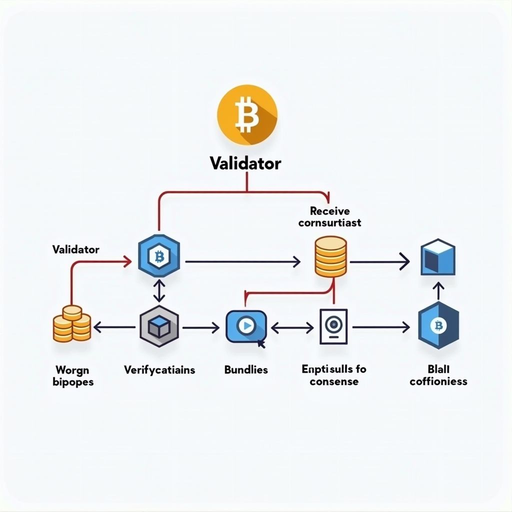
Validators perform several essential functions. They collect pending transactions from the network's memory pool and verify that each transaction is valid according to the network's rules. This includes checking that senders have sufficient funds, that cryptographic signatures are correct, and that transactions don't violate any protocol rules. Validators then bundle valid transactions into blocks and propose these blocks to the network.
Beyond creating blocks, validators maintain a complete copy of the blockchain and continuously verify new blocks proposed by other validators. They participate in the consensus process by following the protocol's rules for accepting or rejecting blocks. Validators also relay transactions and blocks to other nodes, helping propagate information across the network. This redundancy ensures that the network remains operational even if some validators go offline.
Validator Requirements and Incentives
The requirements to become a validator vary significantly across different blockchain networks. PoW networks require specialized mining hardware and access to affordable electricity. PoS networks typically require validators to stake a minimum amount of cryptocurrency, which can range from modest amounts to substantial holdings depending on the network. Some networks also have technical requirements regarding network connectivity, uptime, and computational resources.
Validators are incentivized through rewards, which typically come from two sources: newly created cryptocurrency (block rewards) and transaction fees paid by users. The reward structure is designed to make honest validation profitable while making attacks economically unviable. In PoS systems, validators also face the risk of slashing—losing part or all of their staked assets if they behave maliciously or fail to maintain adequate uptime and performance.
Network Security and Attack Vectors
The security of blockchain networks depends fundamentally on their consensus mechanisms. Understanding potential attack vectors and how consensus protocols defend against them is essential for evaluating blockchain security. While no system is perfectly secure, well-designed consensus mechanisms make attacks prohibitively expensive or technically infeasible.
The 51% Attack
The most commonly discussed attack vector is the 51% attack, where an attacker controls more than half of the network's validation power (computational power in PoW or staked assets in PoS). With majority control, an attacker could potentially reverse recent transactions, prevent new transactions from confirming, or double-spend cryptocurrency. However, even with 51% control, attackers cannot steal funds from other users' wallets or create cryptocurrency out of thin air, as these actions would be rejected by the network's protocol rules.
The cost of mounting a 51% attack varies dramatically across networks. Large, established networks with substantial validation power are extremely expensive to attack. Smaller networks with less validation power are more vulnerable, which is why new blockchain projects often face greater security risks until they achieve sufficient scale and decentralization.

Long-Range Attacks and Finality
PoS systems face unique security considerations, including long-range attacks where an attacker attempts to create an alternative blockchain history starting from a point far in the past. Various mechanisms have been developed to prevent this, including checkpointing and weak subjectivity, where nodes rely on recent trusted states to reject obviously fraudulent alternative chains.
Different consensus mechanisms provide different guarantees about transaction finality—the point at which a transaction is considered irreversible. PoW systems offer probabilistic finality, where confidence in a transaction increases with each subsequent block. Some PoS and BFT-based systems offer deterministic finality, where transactions are immediately final once confirmed. Understanding finality is important for applications that require certainty about transaction completion.
Network-Level Attacks
Beyond consensus-level attacks, blockchain networks face network-level threats such as eclipse attacks, where an attacker isolates a node from the rest of the network, and denial-of-service attacks that attempt to overwhelm validators with traffic. Robust network design, including diverse peer connections and DDoS protection, helps mitigate these risks. The decentralized nature of blockchain networks provides inherent resilience, as there's no single point of failure to target.
Consensus Design Trade-offs
Designing a consensus mechanism involves navigating fundamental trade-offs between competing priorities. No consensus mechanism is objectively "best"—each represents a different balance of trade-offs suited to particular use cases and priorities. Understanding these trade-offs helps explain why different blockchain networks make different design choices.
The Blockchain Trilemma
The blockchain trilemma describes the challenge of simultaneously optimizing for three properties: decentralization, security, and scalability. According to this concept, blockchain systems can typically achieve only two of these three properties at high levels. For example, a highly decentralized and secure network might sacrifice transaction throughput, while a highly scalable system might require some centralization or security compromises.
PoW networks like Bitcoin prioritize decentralization and security but have limited scalability. Some newer networks prioritize scalability and security through more centralized validator sets. Others attempt to find middle grounds or use layer-2 solutions to address scalability while maintaining base-layer security and decentralization. The trilemma isn't an absolute law, but it captures real constraints that consensus designers must navigate.
Energy Efficiency vs. Security
The energy consumption of PoW has driven innovation toward more efficient consensus mechanisms, but this efficiency comes with different security assumptions. PoW's energy consumption is often viewed as a feature rather than a bug—it represents the real-world cost of attacking the network. PoS achieves efficiency by replacing energy expenditure with capital lockup, creating security through economic stake rather than computational work. Each approach has merit, and the choice depends on priorities regarding environmental impact, security model, and economic design.
Permissionless vs. Permissioned
Consensus mechanisms can be designed for permissionless networks where anyone can become a validator, or permissioned networks where validators are pre-approved. Permissionless systems maximize decentralization and censorship resistance but face challenges with scalability and governance. Permissioned systems can achieve higher performance and efficiency but sacrifice some degree of decentralization and trustlessness. Many enterprise blockchain applications use permissioned consensus mechanisms, while public cryptocurrencies typically use permissionless approaches.
The Future of Consensus Mechanisms
Consensus mechanisms continue to evolve as blockchain technology matures. Researchers and developers are exploring new approaches that attempt to overcome current limitations and find better balances between competing priorities. Innovations like sharding, which divides the network into parallel processing groups, and layer-2 solutions that handle transactions off the main chain while inheriting its security, represent ongoing efforts to improve blockchain scalability without sacrificing decentralization or security.
Understanding consensus mechanisms provides essential insight into how blockchain networks function and what makes them secure. Whether a network uses Proof of Work, Proof of Stake, or alternative approaches, the consensus mechanism determines how the network reaches agreement, processes transactions, and maintains integrity without central authority. As blockchain technology continues to develop, consensus mechanisms will remain a critical area of innovation, shaping the capabilities and characteristics of future decentralized networks.
For anyone seeking to understand blockchain technology deeply, grasping consensus mechanisms is fundamental. These protocols represent the technical solution to achieving trust and coordination in decentralized systems, enabling the revolutionary applications that blockchain technology makes possible. As you continue learning about blockchain, the concepts covered here will provide a foundation for understanding how different networks operate and why they make particular design choices.